
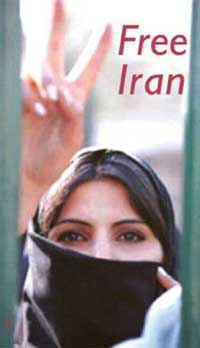
It is important to place the current crisis in Iran in its proper context. First, our grievances are with the radical theocratic regime, not the Iranian people as a whole.
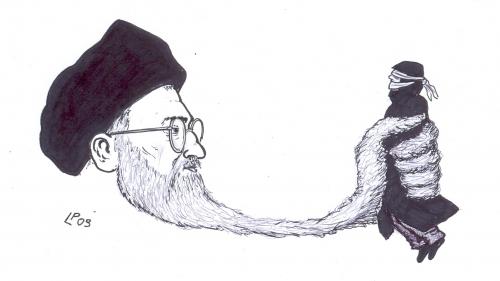
Second, our concerns are not limited to the nuclear issue and Israel - the regime is a threat to not only Israel, but to the region and to world stability.

Third, the Iranian regime must be recognized for what it is:
- clearly guilty of inciting genocide, as is evident in this 2009 paper from Middle East Quarterly;
- an enthusiastic supporter of international terrorism through its proxies such as Hamas and Hezbollah;
- brutally repressive against any Iranian minority groups such as the Kurds and the Baha'i; and
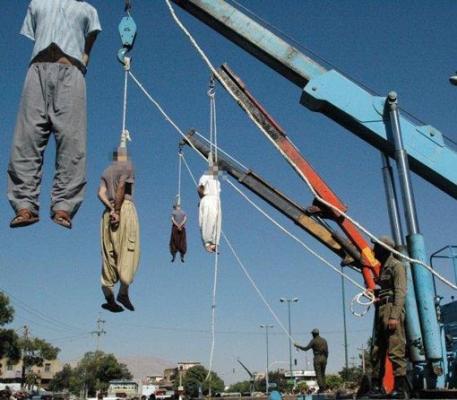
- brutally repressive against any form of political dissent.

So in that context, I will try to briefly summarize some of what I learned at the conference.
The Honorable Irwin Cotler, an expert in international law and a member of Canada's Parliament says that while he favors engagement with Iran, there must be specific limits and goals, that engagement must also address the other issues noted above, and that the West must not abandon the Iranian people. He suggested a variety of targeted and calibrated responses ranging from sanctions against Iranian petroleum imports, the Iranian financial and banking industry, companies doing business with Iran that has the effect of supporting Iranian domestic policies, targeting the Iranian Revolutionary Guard Corps, and targeting specific individuals, such as, for example, Iranian Defence Minister Ahmad Vahidi, for whom there is an Interpol arrest warrant in connection with the terror attacks in Buenos Aires in 1994. He also strongly supports action through the United Nations, such as a Canadian-sponsored Resolution at the UN General Assembly. Finally, he pointed out that the American Cold War strategy must be used again - not only did the US push for arms control, it also strongly the supported the cause of Russian dissidents.
A motion condemning Iran for its human rights record and its pursuit of nuclear weapons was unanimously adopted by all parties - the text of which is as follows:
The Parliament of Canada
HOUSE OF COMMONS MOTION
IRAN
Adopted Unanimously, October 27, 2009That, in the opinion of this House,
- Canada supports the democratic aspirations of the people of Iran.
- Canada condemns the use of violence and force by Iranian authorities against their own people to suppress pro-democracy demonstrations following the Iranian presidential elections of June 12, 2009.
- Canada condemns the use of torture by Iranian authorities.
- Canada calls for the immediate release of all political prisoners held in Iran.
- Canada calls on Iran to fully respect all of its human rights obligations, both in law and in practice.
- Canada condemns Iran’s complete disregard for legally binding UN Security Council Resolutions 1696, 1737, 1747, and 1803 and International Atomic Energy Agency requirements.
- Canada affirms its opposition to nuclear proliferation and condemns any pursuit by Iran of nuclear weapons capability.
- Canada recommends to international organizations of which it is a member that a new set of targeted sanctions be implemented against Iran, in concert with allies, unless it comes into compliance with its human rights and nuclear obligations in law and in practice.
Mark Dubowitz of the Foundation for Defence of Democracies, is another expert on Iran. His comments started with a sobering quote from, of all people, Woody Allen to the effect that when faced with bad and worse options, go with the bad one. That said, he still believes that even at this late date there are options short of military action - not great ones, but options nonetheless. His concern is that the Iranian regime thinks that when they secure nuclear weaponry, they will think that they have guaranteed the stability of their regime. His strategies are similar to those advanced by Professor Cotler - "attack" the Iranian economy, blacklist the Revolutionary Guard, and target those that do business with Iran - information that is fairly readily available on the internet. He pointed out that when British Petroleum was confronted by the US Government (acting under the Iran Refined Petroleum Sanctions Act of 2009) and was faced with deciding between its business in North America or in Iran - it chose its North American business.
In Canada we have similar legislation known as the Special Economic Measures Act, and which to date has only been fully applied against Zimbabwe and Burma - two despicable regimes to be sure - but hardly in the same league as Iran. Mr. Dubowitz advised that due to Canada's wealth of natural resources, we are a significant target of Iranian investment that should be attacked through SEMA.
Ken Timmerman, of Foundation for Democracy in Iran, was the most hawkish of the speakers. In his opinion, when it comes to Iran, we are clearly at 5 minutes to midnight and have been unsuccessfully engaged in engagement with Iran since the Iranian Revolution of 1979. He does not like the continuing engagement process as it allows Iran time to dither and delay while continuing full speed ahead with their nuclear weapons program. While he does not believe that sanctions will work, they must be pursued rigorously.
He also pointed out that all the developments to date - nuclear, terrorism, incitement and human rights abuse - have occurred under so-called moderate Iranian leaders - and now we are faced with a regime that fully believes in the 12th Imam Eschatology - mix that with nuclear weapons and the outlook is grim indeed. He believes that it is a serious mistake for the West to think that the current regime is normal - or to put it in "Clintonian terms" - "It's The Regime Stupid"
Shimon Koffler Fogel, Chief Executive Officer of the Canada-Israel Committee, summed up the conference by urging people to move beyond words to action. he advocated that Canada take the lead with the ultimate goal, to be achieved by April 2010, of completely isolating Iran, listing the Revolutionary Guard Corps as a terrorist entity and listing companies who cooperate with Iran.
Following the conference, the delegates went to Parliament Hill where we met with various parliamentarians to urge them to have Canada take the lead in the international community in taking concrete action against the Iranian regime. I had the great pleasure of meeting MP Michael Savage (Lib) of Dartmouth-Cole Harbour, who has always given a warm and attentive audience to issues that have been brought to his attention.
In closing, I would be remiss if I did not refer to the remarks of:
- Iranian-Canadian lawyer and blogger Sayeh Hassan who spoke to the terrible repression employed in Iran and the need for regime change. Ms. Hassan maintains ongoing contacts with Iranian dissidents in order to support them in their struggle and to document the terrible reality they face daily. She has courageously put her face and name behind the campaign for regime change and
- international human rights activist (among many other talents and activities) Nazanin Afshin-Jam, who bravely documents the horrors of human rights abuses in Iran, as well as in China, Darfur, Burma and other tyrannical regimes, and then speaks out against them (check out her web-site - http://www.nazanin.ca/). She has recorded the following fantastic video in support of the continuing struggle for human rights and democracy in Iran -


No comments:
Post a Comment
While you are free to disagree with something I have said or posted, you must not use inappropriate language - comments that are profane, racist or otherwise objectionable will not be tolerated.